
- Not a seesaw. The branches occupy a two-dimensional space: they can move reciprocally, together, or independently.
- Sympathetic is not the villain. Standing up, focusing and climbing a hill all require it. Blunted sympathetic response is its own problem.
- Parasympathetic is not always good. Fainting is a parasympathetic event. More vagal tone is not automatically better.
- The LF/HF ratio does not measure balance. Under full autonomic blockade it can paradoxically rise, suggesting sympathetic dominance where there is almost no autonomic activity at all.
- Recovery speed is the useful signal — how fast heart rate drops after effort, not a ratio on a screen.
- Fainting, dizziness on standing or a racing heart at rest are medical questions, not wellness ones.
The Two Branches, Quickly
The autonomic nervous system runs what you do not consciously control. It has two main branches, and their anatomy differs as much as their function.
The sympathetic branch leaves the spinal cord through the thoracic and lumbar segments, which is why it is sometimes called thoracolumbar. It signals mainly with noradrenaline at the target organ. Its job is mobilisation.
The parasympathetic branch leaves through the cranial nerves — above all the vagus — and the sacral segments, hence craniosacral. It signals with acetylcholine. Its job is restoration.
| Organ | Sympathetic | Parasympathetic |
|---|---|---|
| Heart rate | Increases | Decreases |
| Airways | Dilate | Constrict |
| Pupils | Dilate | Constrict |
| Digestion | Slows | Stimulates |
| Saliva | Thick, sparse | Watery, plentiful |
| Blood to skeletal muscle | Increases | Returns to baseline |
| Bladder | Relaxes (retains) | Contracts (empties) |
| Main transmitter at the organ | Noradrenaline | Acetylcholine |
| Outflow | Thoracolumbar spinal | Vagus and sacral nerves |
One tidy exception worth knowing, because it shows the textbook split is a simplification: most sweat glands are sympathetically innervated but use acetylcholine, the parasympathetic transmitter. Stress sweat is a sympathetic event carried by a “parasympathetic” molecule.
The Third Branch Nobody Mentions
The two-branch model is a simplification in another way as well. The gut has its own division of the autonomic nervous system — the enteric nervous system — containing on the order of several hundred million neurons embedded in the wall of the digestive tract.
It is unusual because it can operate semi-independently. Isolated from central input, a segment of intestine will still coordinate the wave of muscular contraction that moves contents along. Sympathetic and parasympathetic fibres modulate it, but they do not run it.
There is a further detail that reframes how people usually picture the vagus. Most of its fibres are afferent — they carry information from the organs up to the brain, not commands down. The vagus is predominantly a sensory cable. When wellness content describes "stimulating the vagus nerve" to send calming signals downward, it has the traffic largely backwards: the bigger flow is the body reporting its state upward, where the brain uses it to decide what to do next.
That is also why digestion is such an honest readout. It is the part of the system most sensitive to prolonged mobilisation, and it usually registers a problem before anything else does — which is why unhurried meals are treated as part of the protocol at The Pearl Laguna Beach rather than as hospitality.
The Seesaw Myth
Almost every wellness diagram shows these branches as opposite ends of one slider: push sympathetic down and parasympathetic automatically rises. It is an appealing picture, and it is wrong.
The framework physiologists use instead is the doctrine of autonomic space, set out by Berntson, Cacioppo and Quigley in Psychological Review in 1991. It treats the two branches as two independent axes rather than one dimension, which allows four distinct modes:
- Reciprocal — one rises as the other falls. This is the familiar case, and the reason the seesaw picture survives.
- Coactivation — both rise together. Common in anticipation, and in the diving response.
- Coinhibition — both fall together. Seen, for example, with certain chemoreceptor stimuli.
- Uncoupled — one branch changes while the other stays where it was. The baroreflex can raise parasympathetic activity with no change in sympathetic tone at all.
The immediate consequence: two people can show the same heart rate through completely different autonomic arrangements — one with both branches quiet, the other with both branches driving hard against each other. A single number on the surface tells you nothing about the configuration underneath.
Two people can arrive at the same heart rate through completely opposite physiology. The number on the surface says nothing about the arrangement underneath.
Dr. Maria Dungo — board-certified medical oncologist and hematologist
So What Does “Balance” Actually Mean?
Not an even split. If your sympathetic and parasympathetic activity were equal at all times, you could neither sprint nor sleep.
A better working definition is appropriate matching: each branch responding in proportion to what the moment requires, and coming back afterwards. Sympathetic dominance climbing a hill is correct. Parasympathetic dominance after dinner is correct. The failure mode is not the wrong ratio — it is the wrong timing: mobilisation that will not switch off at 11pm, or a system so flattened that nothing switches on at 9am.
This is the same point we make about the word “regulation” in our guide to what nervous system regulation actually means: the marker is the return, not the state.
Sympathetic Activity Is Not the Enemy
An entire industry has cast fight-or-flight as a malfunction. In reality the sympathetic branch is doing quiet, necessary work all day.
It is what keeps your blood pressure up when you stand, so you do not grey out. It is what raises cardiac output when you climb. It sharpens attention before something difficult. Waking up in the morning is a sympathetic event.
A blunted sympathetic response has real costs of its own: exercise intolerance, dizziness on standing, low motivation, that flattened quality people describe as watching their own life from a distance. When guests arrive at The Pearl Laguna Beach convinced they need to suppress their stress response entirely, this is usually the first correction — the goal is a response that switches on cleanly and off promptly, not one that has been turned down to nothing.
Your Autonomic Day Has a Shape
Balance is not only a question of how you respond to events. It also has a daily rhythm, and that rhythm is where a lot of chronic stress becomes visible.
Across a normal twenty-four hours, vagal influence is at its highest during deep NREM sleep — the point at which heart rate falls to its daily minimum and recovery processes run hardest. In the hours before waking, sympathetic activity climbs in preparation, and cortisol rises sharply in the first half hour after you open your eyes. By mid-morning the system is mobilised; through the evening it should tip back.
Two practical consequences follow. First, the morning surge is normal physiology rather than a sign that something is wrong — though it is also why cardiac events cluster in the early hours, which is worth knowing rather than worrying about. Second, and more useful: what people describe as feeling "wired at night and flat in the morning" is often this curve inverted. The evening tip-back is not happening, so the night does not deliver the parasympathetic window, so the morning has nothing to rise from.
That inversion is not fixed by an evening breathing exercise. It is fixed by what happened earlier — morning light, real daytime exertion, and meal timing — which is the argument for treating the day as a sequence rather than as a set of separate interventions.
Parasympathetic Activity Is Not Automatically Good
The mirror-image error is subtler and more common in wellness content: treating vagal tone as a quantity where more is always better.
The clearest counter-example is vasovagal syncope — ordinary fainting. It is a parasympathetic event: an abrupt surge of vagal activity drops heart rate and blood pressure, and the person goes down. Nobody would call that optimal regulation.
Extreme parasympathetic activity also underlies certain bradycardias and contributes to the shutdown state people describe as numbness or collapse rather than calm. Down is not automatically better than up. What matters is whether the response fits the situation.
What Actually Shifts Each Branch
| Raises sympathetic | Raises parasympathetic | |
|---|---|---|
| Seconds | Standing, sudden noise, caffeine, cold shock, sprinting | Prolonged exhale, slow breathing, face immersion in cool water |
| Minutes | Exertion, difficult conversation, bright light, nicotine | Warmth, food, gentle touch, safe company |
| Hours to days | Sleep loss, alcohol the night before, illness, sustained deadline | Deep sleep, aerobic fitness, resolution of a stressor |
| Notes | Heat and cold are not simple opposites here — both are stressors that trigger mobilisation first, with parasympathetic recovery following afterwards. | |
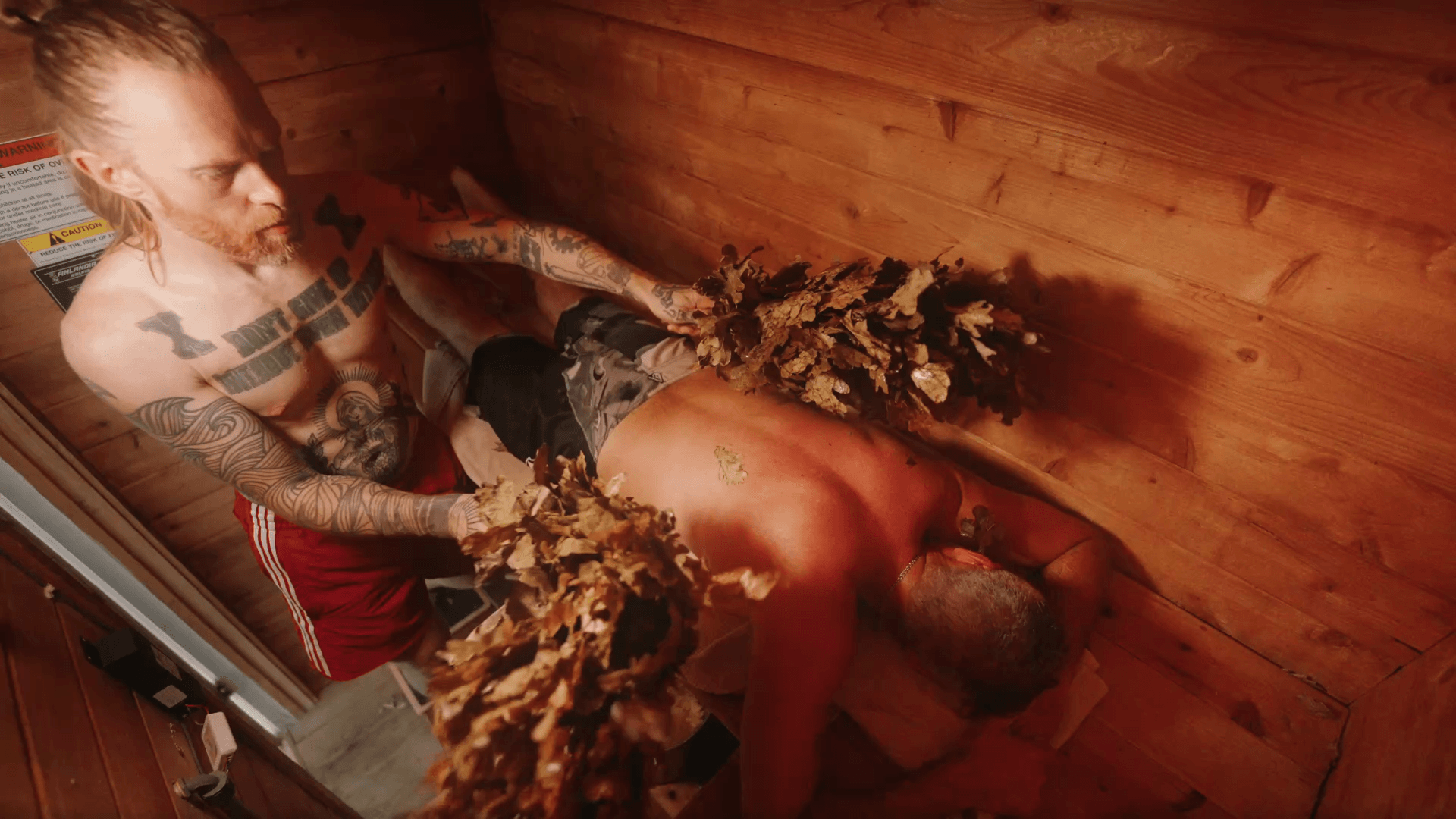
That last row explains why contrast rituals work the way they do. A session in the Russian Banya followed by a cold plunge is not a relaxation exercise — it is a sequence of genuine stressors with a pronounced recovery on the other side. The calm afterwards is the rebound, not the stimulus.
Can You Measure Your Own Balance? Mostly No
This is where consumer technology has got ahead of the physiology.
Many wearables and apps report an LF/HF ratio from heart rate variability and label it “sympatho-vagal balance” or “stress index”. The idea is that low-frequency power reflects sympathetic activity, high-frequency power reflects parasympathetic activity, and the ratio therefore shows which branch is winning.
George Billman laid out the case against this in Frontiers in Physiology in 2013, under a title that leaves little room for doubt: The LF/HF ratio does not accurately measure cardiac sympatho-vagal balance. The problems compound:
- LF is not sympathetic. Parasympathetic influence accounts for at least half of LF variability, sympathetic influence only around a quarter.
- The ratio survives the removal of its own subject matter. Under pharmacological blockade of both branches, LF power persists at roughly a quarter of baseline — and the LF/HF ratio can rise, implying sympathetic dominance in a body with almost no autonomic activity left.
- HF is not purely parasympathetic either; sympathetic activity may modulate it by around ten per cent.
- The premise fails. The ratio assumes reciprocal antagonism, which — per the autonomic space framework above — is only one of four possible modes.
- Breathing contaminates it. Respiratory rate and tidal volume strongly influence the low-frequency component, and most human studies control neither.
Billman's conclusion is blunt: the sympatho-vagal balance hypothesis, as operationalised by this ratio, has been disproven. If your device shows you a balance score, treat it as a mood ring with a decimal point.
Total HRV and vagally-mediated measures such as RMSSD remain useful — as a personal trend over a week, not as a daily verdict, and with the caveats we set out in our guide to what a nervous system reset actually is.
Signals That Are Actually Worth Watching
All of these are about recovery, which is the thing that genuinely varies with fitness and load:
- Heart rate recovery after effort. How quickly your pulse falls in the first minute after a hard climb. Parasympathetic reactivation after exercise is well studied and improves with training.
- Resting heart rate on waking, tracked as a weekly average rather than a daily number.
- How you feel on standing up. Brief lightheadedness that resolves is ordinary; consistent dizziness is not.
- Time to settle after something stressful. Hours rather than the rest of the day.
- Digestion and sleep onset — both parasympathetic-dependent and both quick to report a problem.
How This Shapes a Week at The Pearl Laguna Beach
If balance is matching rather than suppression, a retreat that only offers stillness is training half the system. The week at our Laguna Beach, California wellness retreat is built as a series of genuine oscillations:
- Real sympathetic demand. Guided canyon hikes, morning power yoga and strength work — effort that actually raises cardiac output, not a gentle stroll.
- Real parasympathetic recovery. Daily massage therapy, evening restorative practice, sound healing and unhurried plant-based meals.
- Deliberate contrast. The Banya, infrared sauna, cold plunge and saltwater jacuzzi, run as a sequence rather than as separate amenities.
- Sleep as the anchor. The deepest parasympathetic window of the day, protected by light timing, meal timing and dark, quiet rooms.
Repeated across several days, that oscillation is the training stimulus. A flat week of relaxation is not.
When This Is a Medical Question
Some autonomic symptoms need a physician rather than a breathing practice. See a doctor promptly for fainting or near-fainting, persistent dizziness or palpitations on standing, a resting heart rate that stays unusually high or low, chest pain, or a marked and unexplained change in heart rate patterns.
Conditions such as POTS, other forms of dysautonomia, thyroid disease, anaemia, arrhythmias and several medication effects all present through the autonomic system and all have specific treatments. None of them improve because someone lengthened their exhale. The same caution applies to the exhaustion that shades into burnout and chronic stress, where a medical cause is genuinely easy to miss from the inside.
Frequently Asked Questions
What is the main difference between the sympathetic and parasympathetic nervous systems?
The sympathetic branch mobilises the body — raising heart rate, dilating airways and pupils, redirecting blood to muscle — and signals mainly with noradrenaline from thoracolumbar spinal outflow. The parasympathetic branch restores: it slows the heart, supports digestion and repair, and signals with acetylcholine, largely through the vagus nerve.
Are the sympathetic and parasympathetic systems opposites?
Not strictly. They often move reciprocally, but they can also rise together, fall together, or change independently. The doctrine of autonomic space, introduced by Berntson, Cacioppo and Quigley in 1991, treats them as two separate axes rather than one dial, which is why a single surface measure cannot reveal the underlying configuration.
What does autonomic balance actually mean?
Not a 50/50 split, which would make both sprinting and sleeping impossible. It means each branch responding in proportion to what the situation requires and returning afterwards. The problem in chronic stress is timing — mobilisation that will not switch off — rather than a wrong ratio.
Can a wearable measure my sympathetic and parasympathetic balance?
Not reliably. The LF/HF ratio commonly presented as "autonomic balance" was directly challenged by Billman in Frontiers in Physiology in 2013: low-frequency power is more parasympathetic than sympathetic in origin, the ratio can rise under full autonomic blockade, and breathing pattern strongly contaminates it. Vagally-mediated measures such as RMSSD are more meaningful, read as a weekly trend.
Is too much parasympathetic activity bad?
It can be. Ordinary fainting — vasovagal syncope — is a parasympathetic event in which a surge of vagal activity drops heart rate and blood pressure. Extreme vagal activity also underlies certain bradycardias. More vagal tone is not automatically better; appropriateness matters more than quantity.
How do I activate my parasympathetic nervous system?
Prolonged exhales and slow breathing at around six breaths per minute shift autonomic balance within minutes, as do warmth, food, gentle touch and safe company. These change your state now. Changing where your baseline sits takes weeks of consistent sleep, aerobic fitness and reduced load.
Does the cold plunge activate the parasympathetic system?
Not during immersion. Cold is a sympathetic stressor — heart rate and blood pressure rise sharply. The parasympathetic effect is the rebound afterwards, which is why contrast rituals are best understood as training the recovery rather than as relaxation.
A Week Built on Oscillation, Not Stillness
The Pearl Laguna Beach runs small-group programmes — from a short reset to the flagship 1-Week Transformation — at an intimate twelve-room canyon sanctuary in Laguna Beach, California, with a maximum of twelve guests and Sunday arrivals. Real effort in the morning, real recovery in the afternoon, repeated until the return gets faster.
Request Availability at The Pearl Laguna Beach
Prefer to shape your own stay? Design your retreat, or read the retreat booking information first.
Dr. Maria Dungo is a board-certified medical oncologist and hematologist with more than 25 years of experience serving patients throughout Southern California. As Owner of The Pearl Laguna Beach wellness retreat, she combines evidence-based medicine with a commitment to prevention, yoga, healthy living, nutrition, stress reduction and whole-person wellness. Her work at the retreat is built around a single question: what helps people build habits that hold up over years, not weeks?
Written and medically reviewed by Dr. Maria Dungo, board-certified medical oncologist and hematologist, on 19 September 2026. This article is for general education and is not medical advice. It is not a substitute for diagnosis or treatment by a qualified healthcare professional. Fainting, persistent dizziness, palpitations or chest pain should be assessed by a physician without delay.
- Billman GE. The LF/HF ratio does not accurately measure cardiac sympatho-vagal balance. Frontiers in Physiology. 2013;4:26
- Berntson GG, Cacioppo JT, Quigley KS. Autonomic determinism: the modes of autonomic control, the doctrine of autonomic space, and the laws of autonomic constraint. Psychological Review. 1991;98(4):459–487
- Berntson GG, et al. Autonomic space and psychophysiological response. Psychophysiology. 1994
- Stanley J, Peake JM, Buchheit M. Cardiac parasympathetic reactivation following exercise: implications for training prescription. Sports Medicine. 2013
- Goldberger JJ, et al. Assessment of parasympathetic reactivation after exercise. Am J Physiol Heart Circ Physiol. 2006
- Thayer JF, et al. Heart rate variability, prefrontal neural function, and cognitive performance
- Balban MY, et al. Brief structured respiration practices enhance mood. Cell Reports Medicine. 2023
- Goessl VC, et al. HRV biofeedback training on stress and anxiety: a meta-analysis. Psychological Medicine. 2017
- Cain T, et al. Effects of cold-water immersion on health and wellbeing. PLOS ONE. 2025
- Grossman P. Fundamental challenges to the polyvagal theory. Biological Psychology. 2023