

- Walks under twenty minutes produced no statistically significant cortisol effect in the field study that looked for one. Twenty to thirty minutes did.
- A 50-minute nature walk improved backward digit span from 7.90 to 9.40; the same walk downtown moved it 7.90 to 8.40, which was not reliable.
- After a 90-minute walk in greenspace, blood flow in the subgenual prefrontal cortex fell sharply. The self-reported drop in rumination in the same study was only marginally significant at P = 0.07.
- After one hour in a Berlin forest, amygdala activity decreased. After an hour on a busy shopping street it stayed flat — it did not rise.
- 120 minutes a week was associated with reporting good health and high wellbeing. The association plateaued at 200–300 minutes and the study cannot show direction of cause.
- Fifteen randomised trials pooled in 2026 put outdoor exercise ahead of indoor exercise for mental health, on evidence the authors describe as moderate risk of bias.
- Nobody has measured how long any of it lasts once you go back inside. That gap is the honest centre of this subject.
Almost everything written about hiking and mental health describes a direction — you will feel better — without a clock. That is the part worth fixing, because the research does have a clock, and it does not say what the genre says. It says that short walks are mostly unmeasurable, that attention recovers before mood does, that the most striking brain findings come from single sessions of an hour or ninety minutes, and that the only long-range numbers anyone has are the kind that cannot establish cause.
What follows is that timeline, in order, with the size of each study and its weakness stated at each mark. The practical reason to read it this way: the commonest mistake is a ten-minute walk around the block, taken in the belief that it is what the studies measured. It is not.
The First Twenty Minutes: Mostly Nothing Measurable
The cleanest field study of short nature exposure asked 36 urban adults in Michigan to take at least three outdoor breaks a week for eight weeks, choosing their own time, place and duration, with aerobic exercise excluded. Saliva was collected before and after each one, and the pre-break samples were used to establish what each person's stress markers were doing anyway on a normal day — which matters, because cortisol falls across the day on its own.
Breaks between seven and twenty minutes showed no significant effect. That is not the same as nothing happening, and it is not a reason to skip a short walk, which may be pleasant and is certainly better than the alternative of not moving. But it does mean that the familiar advice to step outside for ten minutes sits below the detection threshold of the research used to justify it. The honest version is that at ten minutes you are doing something reasonable with no measured outcome attached to it.
Twenty to Thirty Minutes: The Cortisol Window
In the same study, outdoor breaks of twenty-one to thirty minutes produced a cortisol decline of 18.5% per hour beyond the normal daily drop of 11.7% per hour. Longer breaks kept adding, but at the slower rate of 11.4% per hour — so the efficiency, the amount of stress-hormone change per minute spent, peaked in that twenty-to-thirty-minute band and then fell off.
One detail from that paper tends to get lost. On alpha-amylase, the other stress marker measured, the low-exertion breaks — sitting, or sitting with a little walking — produced a 28.1% hourly decline, while the walking breaks produced about 4%, indistinguishable from the daily trend. Walking is not the active ingredient in everything. For one of the two markers, sitting outdoors did better than walking outdoors.
The limits here are real and the authors name them. Thirty-six people, 92% of them women, one American city, one summer, settings and behaviour uncontrolled, and volunteers who signed up for a nature study and therefore probably liked nature. This is a starting point, not a dose chart.
Fifty Minutes: Attention Comes Back
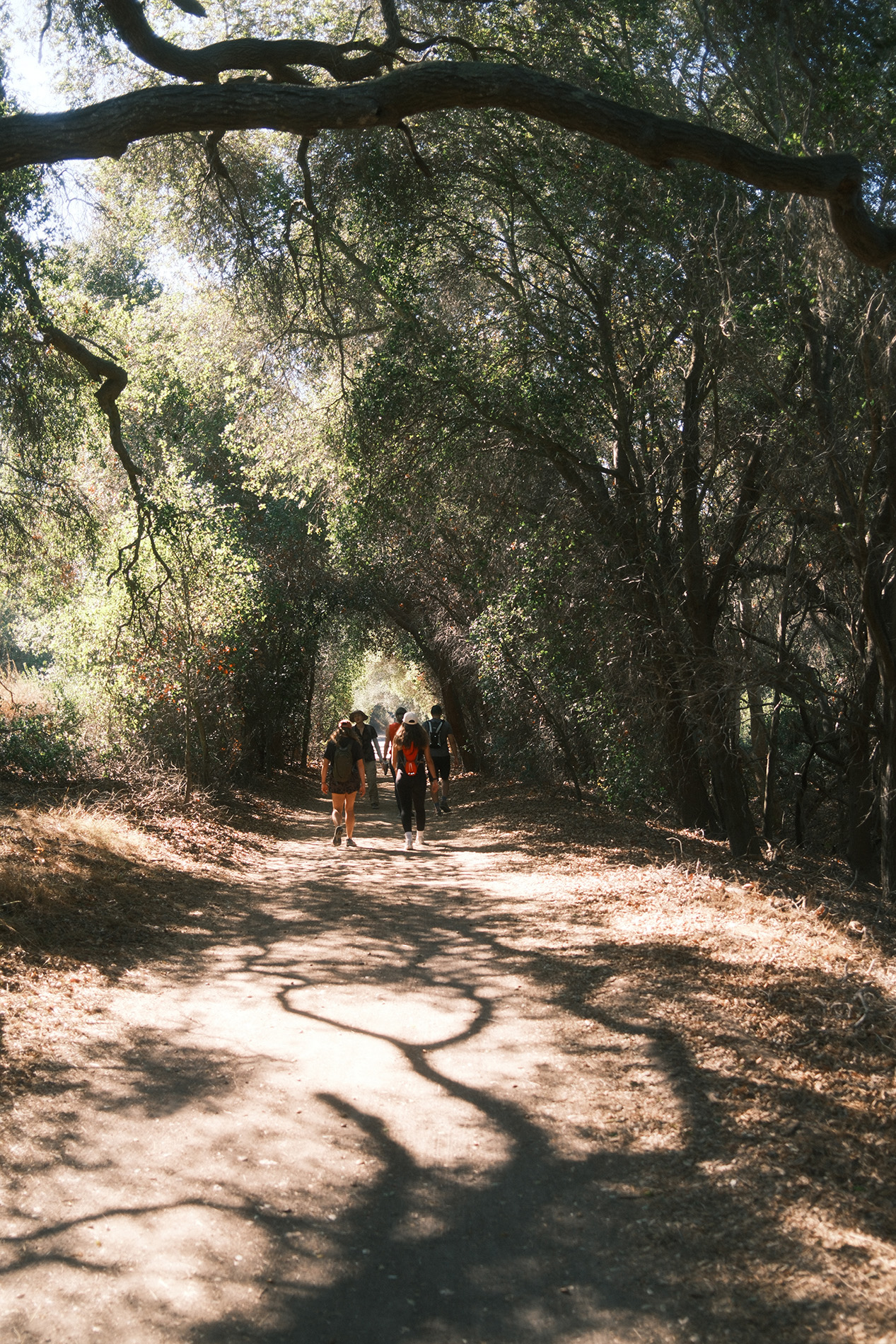
The oldest result in this literature is also the most replicated, and it is about attention rather than mood. In 2008, 37 students at the University of Michigan walked 2.8 miles in either a tree-lined arboretum or along a traffic-heavy street downtown — fifty to fifty-five minutes each way round, one week apart, order counterbalanced so each person did both.
Backward digit span, a working-memory task with a maximum score of 14, went from 7.90 to 9.40 after the arboretum. After the downtown walk it went from 7.90 to 8.40, a change that was not statistically reliable. A second experiment in the same paper used photographs instead of real places and found the same direction, though with twelve participants and an interaction term that did not reach reliability.
The framework usually attached to this is attention restoration: ordinary urban environments demand continuous directed attention, natural ones hold attention without demanding it, and the directed-attention system recovers in the interval. Whether that is the right mechanism remains open. What is not in much doubt is the finding itself, which has held up across repeated attempts in a way that most results in this field have not.
Sixty to Ninety Minutes: What Shows Up in a Scanner
Two imaging studies account for most of what people have heard about this subject, and both are more interesting read closely than read in summary.
The first, published in 2015, sent 38 Bay Area adults on a 90-minute, 5.3-kilometre walk either through Stanford greenspace or along El Camino Real, a multi-lane road in Palo Alto. Blood flow in the subgenual prefrontal cortex — a region implicated in rumination and in sadness more broadly — dropped sharply after the nature walk and did not change after the urban one. That interaction was strong: P < 0.0001.
The self-report result was weaker, and this is the part the coverage dropped. Rumination scores in the nature group fell from 35.39 to 33.06. In the urban group they were flat. But the time-by-environment interaction, the test of whether the two groups actually differed in how they changed, came out at P = 0.07 — marginal, not conventionally significant. So the brain measure moved convincingly and the questionnaire moved suggestively, and anyone who tells you a 90-minute walk is proven to reduce rumination is reporting the stronger half of a split result.
The second study, from 2022, scanned 63 people before and after one hour in Berlin's Grunewald forest or on a busy shopping street. Amygdala activity fell after the forest walk. After the street walk it stayed stable — and the authors specifically flag that, because it argues against the comfortable assumption that cities actively damage you. On this evidence nature improves something rather than the city breaking it.
The brain scan moved convincingly. The questionnaire moved suggestively. Reporting only the first is how a careful study becomes a confident headline.
The Rest of the Day: Where the Evidence Stops
This is the mark on the timeline with nothing on it, and it deserves its own section precisely because it is empty.
Every study above measured immediately after the walk. The 2011 review of outdoor versus indoor exercise — eleven trials, 833 adults — took its wellbeing measures soon after each session and called for research on longer-term effects, which fifteen years later remains largely uncollected. Nobody has established how long a 90-minute walk's effect on rumination persists, or whether the attention gain is still there at bedtime.
That absence is not evidence the effects vanish; it is evidence the question has not been asked properly. The one adjacent finding we do have — a measured increase in brain GABA after twelve weeks of yoga that was gone eight days after people stopped — suggests practices of this kind behave like maintenance rather than treatment, and that frequency matters more than any single long walk.
120 Minutes a Week: The Only Dose Anyone Has Named
The number that reached the press came from 19,806 people in England, surveyed about the previous week's contact with nature. Compared with people reporting none, those reporting 120 to 179 minutes had higher odds of describing their health as good, with an odds ratio of 1.59, and of scoring high on wellbeing, at 1.23. The association rose up to roughly 200–300 minutes a week and then flattened — no additional benefit beyond that.
It held across age, sex, occupational class, long-term illness, and whether people lived in greener or less green neighbourhoods, which is the part that makes it worth quoting. It also cannot tell you which way the arrow points. People in good health get outdoors more easily; feeling well makes a two-hour walk likelier, not only the reverse. The authors say plainly that prospective and intervention studies are the next step. Two hours a week is a defensible target and not a demonstrated prescription.
Weeks and Months: Outdoors Versus the Gym
The most recent attempt to settle whether the outdoor part adds anything pooled fifteen randomised trials and 809 adults in 2026. Against no-exercise controls, outdoor exercise produced a standardised mean difference of −0.96 on a composite of depression, anxiety and distress. Indoor exercise produced −0.21, which was not statistically significant. Head to head, outdoor beat indoor by −0.75.
Treat that with the caution the authors ask for. Risk of bias across the included trials was moderate, with several weakened by dropout. The indoor comparison group lumps treadmills and gyms together with urban street walking. Trial durations ranged from a single session to six months, which is a lot of heterogeneity to average. The indoor-versus-control link in the network rests on a single multi-arm trial. The direction is consistent with the acute studies; the size of the gap is not something to quote with confidence.
For context, the largest exercise-and-depression analysis to date — 218 randomised trials — found walking and jogging, yoga and strength training all effective, without establishing a winner. Hiking is a long walk with a view: it sits inside that literature rather than above it.
A Childhood: The Longest Scale and the Weakest Inference
At the far end of the timeline is a Danish registry study of more than 900,000 people, which linked satellite-measured greenness around childhood addresses to later psychiatric diagnoses. Children growing up with the most surrounding green space had up to 55% lower risk of developing a psychiatric disorder than those with the least, after adjustment for urbanisation, socioeconomic factors and family psychiatric history.
It is a remarkable dataset and it is still observational. Where green space sits in a country is not random, and no amount of adjustment makes a neighbourhood a randomised assignment. The result belongs in a conversation about urban planning. It says nothing about what a walk this afternoon will do, and it is routinely deployed as though it did.
The Whole Timeline in One View
| Mark | What was measured | Evidence strength |
|---|---|---|
| 7–20 minutes | No significant change in salivary cortisol | One field study, 36 people |
| 21–30 minutes | Cortisol down 18.5%/hour beyond the daily decline; most efficient band | Same study; small, 92% female |
| 50 minutes | Working memory 7.90 → 9.40 after nature, 7.90 → 8.40 after downtown | Within-subject, 37 students, well replicated |
| 60 minutes | Amygdala activity decreased after forest; unchanged after city street | 63 people, fMRI, randomised |
| 90 minutes | sgPFC blood flow down sharply (P < 0.0001); rumination down marginally (P = 0.07) | 38 recruited, 31 scanned; split result |
| Rest of the day | Not measured by anyone | No data |
| 120 min/week | Higher odds of good health (OR 1.59) and high wellbeing (OR 1.23); plateau at 200–300 | 19,806 people, cross-sectional |
| Weeks to 6 months | Outdoor exercise ahead of indoor on mental health, SMD −0.75 | 15 RCTs, 809 adults, moderate bias risk |
| A childhood | Up to 55% lower psychiatric risk with most surrounding green space | 900,000+ people, observational |
What Does Not Change on This Timeline
A timeline is a persuasive shape, and it can quietly promise more than the underlying studies do. Four things stay fixed no matter how far along it you walk.
None of these studies treated a diagnosed illness. The acute experiments used healthy adults, and the authors of the 90-minute study say directly that their findings may not extend to people with clinical depression. Hiking is not a treatment for depression, anxiety disorders or PTSD, and a trail is not a substitute for care that works.
The walk does not reach the thing you are walking away from. If what is exhausting you is a workload, a conflict or a diary with no gaps in it, two hours in a canyon changes your afternoon and not the diary. That is worth saying because the literature on burnout is fairly clear that recovery practices stacked on top of an unchanged load produce temporary relief, not recovery.
Rumination is portable. People can and do carry a loop up a hill intact. The 90-minute finding was an average across a group, with the self-report half of it marginal. Individual variation in these studies is wide, and some people need something that interrupts the loop more directly than scenery — which is part of why slow breathing has its own evidence base and why the two are often prescribed together.
Effort is not the variable. Nothing in this evidence rewards a harder hike. The amylase result pointed the other way, the cortisol efficiency peaked at half an hour, and the literature on rest consistently finds that movement which is not a performance does the work. A graded climb to a summit is a fine thing to want. It is not what was measured.
Hiking in Laguna Beach: What Is Actually Here
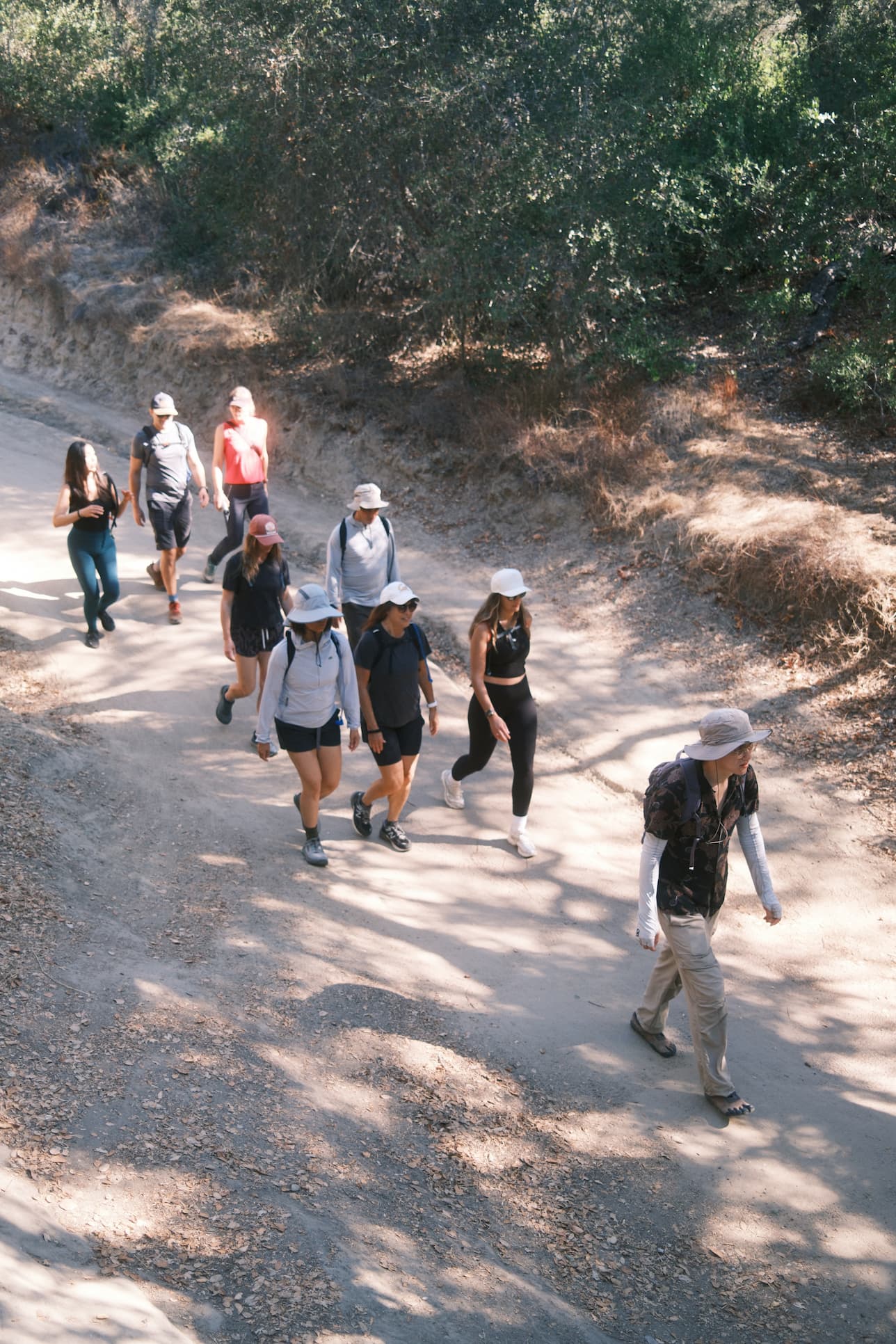
Laguna Beach is unusually well set up for this, for an accidental reason: the city is ringed by protected wilderness that was never built on, so the trailheads are minutes from the coast rather than an hour inland. Three parks carry most of it, and the useful question for anyone reading the timeline above is which routes are long enough to reach the twenty-to-thirty-minute band and which get you to fifty or ninety.
| Where | Scale | Hours | Notes |
|---|---|---|---|
| Laguna Coast Wilderness Park | Canyon trails inland of Laguna Canyon Road; Willow Staging Area is the main access | 8am–5pm | Shortest window of the three; closes before an evening walk |
| Aliso and Wood Canyons Wilderness Park | More than 30 miles of trail | 7am–9pm | Longest hours, widest choice of distances |
| Top of the World, Alta Laguna Park | Ridge access with ocean and canyon views; links into Aliso and Wood Canyons | 7am–sunset | Reachable by car for anyone who does not want the climb |
| Canyon Acres to the vista point | About 2.4 miles with roughly 890 feet of climbing, near 2 hours | As above | Steep and short, no switchbacks; park at the metered lot on Laguna Canyon Road rather than the trailhead |
| El Moro Canyon loop, Crystal Cove State Park | About 5 miles, over 800 feet of elevation | 6am–sunset | The longest of these and the one that comfortably clears ninety minutes |
Three things the trail guides tend to understate. Shade is scarce — these are coastal sage and chaparral slopes, not forest, and an inland canyon in the afternoon is noticeably hotter than the beach. Poison oak is common along creek-bottom sections. And rattlesnakes are active in warm months on exactly these ridgelines, which is an argument for staying on the trail rather than for staying home. Hours and closures also change after rain, and the Laguna Coast 5pm closing catches people out most often.
Where This Fits in a Week at The Pearl Laguna
Our retreat sits in Laguna Canyon with the trails starting a few minutes' walk away, and guided hikes run daily, with difficulty set to whoever is walking — from easy canyon paths to steeper climbs. The structure is deliberately unhurried: a few minutes of breath and attention at the start, the walk itself at a pace that allows conversation, and a period of stillness at the end rather than a brisk return to the day.
That shape is chosen to match the evidence above rather than to sound restorative. A daily walk comfortably past the twenty-minute threshold, repeated across a week, is closer to the 120-minutes-a-week figure than most people's ordinary month. And it sits alongside the rest of the movement in the programme instead of standing in for it, because the exercise literature does not single hiking out and neither do we.
What a week cannot do is finish anything. The honest claim is that it is an easy place to establish a rhythm that only means something if it continues at home.
Frequently Asked Questions
How long should a walk be to help mental health?
The best field evidence puts the efficient band at twenty to thirty minutes, where salivary cortisol fell 18.5% per hour beyond its normal daily decline. Below twenty minutes, the same study found no significant effect. Longer walks kept helping but at a slower rate per minute. For attention and the brain-imaging findings, the studies used fifty, sixty and ninety minutes, so those are the marks to aim at if those outcomes are what you want.
Does hiking help with anxiety?
The evidence is suggestive rather than settled. A 2026 pooled analysis of fifteen randomised trials found outdoor exercise outperformed indoor exercise on a composite measure of depression, anxiety and distress, and a one-hour forest walk reduced amygdala activity in a 63-person imaging study. None of this makes hiking a treatment for an anxiety disorder, and the trials were mostly short with moderate risk of bias.
Is hiking better than running or the gym for mood?
On current evidence the outdoor setting appears to add something — outdoor exercise beat indoor by a standardised mean difference of −0.75 in the 2026 analysis. But the largest study of exercise and depression, covering 218 randomised trials, found walking, jogging, yoga and strength training all effective without a clear winner. The activity you will actually repeat matters more than which one it is.
How often should I hike for the benefits?
The only population-level figure anyone has named is 120 minutes a week in nature, associated with higher odds of reporting good health and wellbeing in a survey of 19,806 people in England, with the association plateauing around 200–300 minutes. That is an association, not a prescription. In practice it means something like three or four half-hour walks a week rather than one long weekend hike.
Why do I feel better after a walk in nature?
Several measured things happen at once, which is why no single explanation holds. Cortisol declines faster than its daily baseline, directed attention recovers while the environment holds your attention without demanding it, and activity falls in brain regions linked to rumination and threat processing. Which of these produces the subjective change is not established, and the studies measuring feeling rather than physiology give weaker results than the ones measuring physiology.
Are there good hiking trails in Laguna Beach?
Yes, and unusually close to town. Aliso and Wood Canyons Wilderness Park has more than 30 miles of trail and is open 7am to 9pm; Laguna Coast Wilderness Park closes at 5pm; Top of the World in Alta Laguna Park gives ridge access with ocean views and can also be reached by car. The Canyon Acres route to the vista point is about 2.4 miles with roughly 890 feet of climbing. Shade is limited and rattlesnakes are active in warm months.
Can hiking replace therapy or medication for depression?
No. The acute studies used healthy volunteers, and the authors of the 90-minute walking study note their findings may not generalise to people with clinical depression. Exercise has real evidence as part of care for depressive symptoms, which is different from being a substitute for treatment. If low mood has lasted weeks, that is a conversation for a clinician.
Does it have to be a hike, or is sitting outdoors enough?
Sitting may be enough, and for one marker it was better. In the Michigan field study, low-exertion time outdoors produced a 28.1% hourly fall in alpha-amylase, while walking produced about 4%, indistinguishable from the normal daily trend. Cortisol responded to duration rather than to effort. Nothing in the evidence requires the outing to be strenuous.
Twenty Minutes Is the Floor, Not the Goal
A week where a walk of real length is already on the schedule is the simplest way to find out what the twenty-to-thirty-minute band feels like when it is not squeezed into a lunch break.
The Pearl Laguna is an all-inclusive wellness retreat in Laguna Beach, California: twelve rooms, never more than twelve guests, daily guided hikes from the canyon trailheads, and difficulty set by the person walking. We make no medical claims and we are not a clinical facility.
Written by The Pearl Laguna editorial team on 5 November 2026. This article is for general education and is not medical advice. Hiking is not a treatment for depression, anxiety disorders or PTSD, and nothing here is a reason to delay or decline care. If you have a cardiovascular, respiratory or joint condition, are pregnant, or are returning to activity after illness or injury, speak to a qualified healthcare professional before starting a hiking programme. On local trails, carry water, tell someone your route, and be aware that heat, poison oak and rattlesnakes are genuine hazards in warm months. If low mood or anxiety has persisted for weeks, or you have any thoughts of harming yourself, please contact a medical professional or a crisis service in your country today.
- Hunter MR, Gillespie BW, Chen SY. Urban nature experiences reduce stress in the context of daily life based on salivary biomarkers. Frontiers in Psychology. 2019;10:722 — 36 participants, 92% female, self-selected settings
- Berman MG, Jonides J, Kaplan S. The cognitive benefits of interacting with nature. Psychological Science. 2008;19(12):1207–1212 — 37 students; second experiment's interaction term not reliable
- Bratman GN, Hamilton JP, Hahn KS, Daily GC, Gross JJ. Nature experience reduces rumination and subgenual prefrontal cortex activation. PNAS. 2015;112(28):8567–8572 — rumination interaction P = 0.07; 31 participants in the perfusion analysis
- Sudimac S, Sale V, Kühn S. How nature nurtures: amygdala activity decreases as the result of a one-hour walk in nature. Molecular Psychiatry. 2022;27:4446–4452 — 63 participants; urban walk did not increase amygdala activity
- White MP, Alcock I, Grellier J, et al. Spending at least 120 minutes a week in nature is associated with good health and wellbeing. Scientific Reports. 2019;9:7730 — 19,806 respondents, cross-sectional, self-reported exposure
- Liang Y, Wei X, Min J. Comparative efficacy of green exercise versus indoor exercise for depression and anxiety: systematic review and network meta-analysis. Frontiers in Public Health. 2026;14:1831073 — 15 RCTs, 809 adults, moderate risk of bias, sparse network
- Thompson Coon J, Boddy K, Stein K, et al. Does participating in physical activity in outdoor natural environments have a greater effect on physical and mental wellbeing than indoors? Environmental Science & Technology. 2011;45(5):1761–1772 — 11 trials, 833 adults; authors note a paucity of high-quality studies
- Engemann K, Pedersen CB, Arge L, et al. Residential green space in childhood is associated with lower risk of psychiatric disorders from adolescence into adulthood. PNAS. 2019;116(11):5188–5193 — more than 900,000 people, observational
- Noetel M, Sanders T, Gallardo-Gómez D, et al. Effect of exercise for depression: systematic review and network meta-analysis of randomised controlled trials. BMJ. 2024;384:e075847 — 218 trials; no single modality established as superior
- OC Parks. Aliso and Wood Canyons Wilderness Park — trail mileage, hours and closure notices
- Visit Laguna Beach. Laguna Beach hikes — park hours, trailheads and parking
- Yoga for Anxiety and Depression: What Happens in the Brain
- Breathwork and Mental Health: Can Changing Your Breathing Change Your State?
- Why Rest Is a Biological Need, Not a Luxury
- Burnout vs. Depression: How Can You Tell the Difference?
- Nervous System Regulation: What It Actually Means
- A Wellness Retreat in Laguna Beach, California