

- The coupling is real and ordinary. Heart rate rises on inhalation and falls on exhalation because vagal output to the heart is gated by the respiratory rhythm.
- The exhale is the lever, because that is the half of the cycle in which vagal slowing dominates. Lengthening it shifts the average.
- Six breaths a minute is not mystical. It is roughly the resonance frequency of the blood-pressure control loop, where breathing reinforces the baroreflex instead of cancelling it.
- Resonance frequency differs by body size. It is lower in taller people and in men, which is why a single prescribed count does not suit everyone.
- 223 studies support the effect on HRV — during the session, after a single session, and after multi-session training.
- The number is not vagal tone. A 2025 expert recommendation in Nature Reviews Cardiology says the amplitude "should not be misconstrued as a measure of vagal tone."
- Breathing slowly inflates one standard HRV band by construction, so a dramatic chart during a session partly measures your breathing rate rather than your nervous system.
The Claim, and What Is Wrong With It
You will have met some version of this: breathe slowly to activate your parasympathetic nervous system, or to tone your vagus nerve. Both phrases are doing something misleading, and the misleading part is not the physiology — it is the grammar.
"Activate" implies a switch with two positions. The autonomic nervous system does not work that way; both branches run continuously, and what changes is the balance between them moment to moment. We go through that in sympathetic versus parasympathetic.
"Tone" implies a muscle that gets stronger with training. The vagus is a nerve, and "vagal tone" is a technical phrase for the level of ongoing vagal output — not a fitness metric that accumulates.
What is actually true is more specific and more interesting: breathing is mechanically and neurally coupled to vagal output to the heart, on a beat-by-beat timescale. That coupling is why breathing changes anything at all, and it is what this article is about. For what the vagus is and does more broadly, start with the vagus nerve explained; for how fast the effects arrive, see the breathwork timeline.
How Breathing Reaches the Heart at All
Put two fingers on your wrist and breathe slowly, and you can usually feel it: the pulse quickens slightly as you breathe in and slows as you breathe out. This is a normal, continuous feature of healthy physiology, present whether or not you are paying attention.
The reason is that vagal output to the heart's pacemaker is not steady. It is gated by the respiratory rhythm generated in the brainstem — suppressed during inhalation, restored during exhalation. Because vagal activity slows the heart, the heart is released to speed up on the inhale and pulled back on the exhale.
The term for this has been respiratory sinus arrhythmia, and we will come back to why that name is being retired. The mechanism, though, is settled: the respiratory rhythm modulates vagal outflow, which modulates heart rate.
Two things follow immediately. First, breathing is one of the very few autonomic processes you can take over voluntarily — which makes it the natural handle on a system otherwise closed to conscious control. Second, since the two halves of the breath have opposite effects on heart rate, the ratio between them matters more than the depth of either.
Why the Exhale Specifically
This is the single most useful practical consequence, and it explains why every calming technique ever devised converges on the same instruction.
If vagal slowing dominates during exhalation, then lengthening the exhale relative to the inhale increases the proportion of each cycle spent in the slowing phase. Over a minute, the average shifts. That is the whole mechanism behind extended-exhale breathing, 4-7-8, cyclic sighing and every "breathe out longer than you breathe in" instruction in the category.
It also explains a common beginner failure. People trying to breathe slowly usually do it by making the inhale enormous, which lengthens the phase in which vagal slowing is suppressed and can leave them feeling more activated rather than less. Smaller inhale, longer exhale is not a stylistic preference — it follows from which half of the cycle does the work.
Every calming breathing technique in existence is a different wrapper around one instruction: spend more of each cycle breathing out. The counting schemes are branding; the ratio is the mechanism.
The Traffic Running the Other Way
Everything above describes signals travelling from brainstem to heart. That is the minority of what the vagus does, and the majority may matter more for how a breathing practice actually feels.
The vagus is predominantly a sensory nerve: most of its fibres carry information from the body up to the brain rather than commands down. We set out that anatomy in the vagus nerve explained, where it is the single most commonly inverted fact in wellness writing. Applied to breathing, it means slow breathing is not only an instruction sent downward — it is also a change in the stream of information arriving from below.
Two sources of that stream are relevant. Stretch receptors in the lungs fire in proportion to inflation, so a slow deep pattern changes their timing and rhythm. And the pressure sensors feeding the baroreflex fire with each pulse, so the large blood-pressure swings produced at resonance arrive upstairs as an unusually strong, regular rhythm.
Which makes a plausible proposal: part of what a person experiences as calm during slow breathing may come from this altered afferent traffic reaching the brainstem — a steady, predictable signal from a body that is evidently not in danger — rather than from the heart slowing as such.
Plausible is the operative word. The afferent account is consistent with the anatomy and with what is known about these receptors, and it is not something anyone has demonstrated in humans by isolating the pathway. It belongs in the category of reasonable mechanism rather than established finding, and it is worth knowing mainly because it explains why the subjective effect does not track the cardiac measure as neatly as you would expect. Two different things are happening, and the one you can measure on a wrist is not obviously the one you feel.
Six Breaths a Minute: Where Resonance Comes From
The number six appears everywhere in this field, usually without explanation. The explanation is a feedback loop, and it is genuinely elegant.
Blood pressure is regulated by the baroreflex: pressure sensors detect a rise and the system slows the heart, pressure falls, the system speeds it up again. Like any feedback loop with a built-in delay, it oscillates — and those oscillations have a natural frequency.
Work on heart rate variability biofeedback places that frequency at roughly 0.1 Hz, about six breaths a minute, with later refinement putting the average nearer 0.09 Hz, or about 5.5 breaths. At that rate, heart rate and blood pressure oscillate roughly 180 degrees out of phase, which is the signature of the baroreflex driving the swings. And breathing at that rate sits in phase with the heart rate oscillation, so each breath adds to the baroreflex-driven swing rather than cancelling it.
The result is resonance in the ordinary engineering sense: a single frequency amplified into unusually large, smooth oscillations. The delay that sets the frequency appears to be determined largely by blood volume — which produces a detail almost nobody mentions. Resonance frequency is lower in taller people and in men, who have larger blood volumes. A prescribed universal count is therefore an approximation, and the common experience of one app's protocol feeling wrong while another feels right has a physiological explanation rather than a motivational one.
What the Pooled Evidence Shows
The effect on heart rate variability itself is one of the better-supported findings in the whole breathwork literature.
A systematic review and meta-analysis in Neuroscience and Biobehavioral Reviews screened 1,842 abstracts and included 223 studies of voluntary slow breathing — 172 measuring during the breathing session, 16 immediately after a single session, and 49 after a multi-session intervention. Vagally-mediated heart rate variability increased at all three time points.
That is a substantial body of work pointing the same direction, and it is worth separating from the clinical claims it gets attached to. What is well supported is that slow breathing changes a cardiovascular measure, during and after practice. The authors themselves are careful: they describe the parasympathetic interpretation as suggested rather than demonstrated, and their safety statement — few adverse effects expected — is phrased as an expectation rather than a tested finding.
A separate systematic review of slow breathing, defined as fewer than ten breaths a minute, found the same physiological consistency and notably less consistency in the psychological outcomes: of the included studies, one found reduced anxiety and two found no significant change. The physiology is the sturdy part.
The Measurement Problem Nobody Mentions
Here is where this topic earns a closer look than it usually gets, because an entire consumer industry rests on reading one number as a verdict on your nervous system.
In 2025 an international group of researchers published an Expert Recommendation in Nature Reviews Cardiology proposing that the term respiratory sinus arrhythmia be replaced by respiratory heart rate variability. Part of the reasoning is semantic — "arrhythmia" implies pathology where there is none. But the substantive point is the one that matters here. The panel states that the amplitude of these respiratory heart rate swings should not be misconstrued as a measure of vagal tone. The phenomenon arises from several mechanisms, and although rhythmic changes in cardiac vagal activity are the primary one, the size of the swing is not a dial reading of vagal output.
The panel also recommends treating respiratory heart rate variation as spanning both the low- and high-frequency bands used in conventional analysis, rather than confining it to the high-frequency band as is standard practice.
That recommendation connects directly to the resonance section above, and the connection is the practical punchline. Breathing at around six breaths a minute places the respiratory rhythm inside the low-frequency band. So a session of resonance breathing inflates low-frequency power by construction — the measure goes up because of where your breathing rate sits in the spectrum, not necessarily because something improved. A chart showing a dramatic rise during a slow-breathing session is partly a picture of your breathing rate.
None of this says slow breathing does nothing. It says the number on the screen is a weaker piece of evidence than it is usually presented as being, and that the honest version of "my HRV went up" is "the measure I am looking at responds strongly to breathing slowly, which is what I was doing."
So What Does "Vagal Tone" Support?
The phrase is useful in its proper place and oversold outside it.
In research, higher resting vagally-mediated HRV is associated with better cardiovascular health and is reduced in conditions including chronic heart failure and hypertension. That association is robust at the population level. What does not follow is that a given person can read their own daily number as a scorecard, or that raising it during a five-minute practice is equivalent to improving the underlying state.
It also does not support the broader claims built on top of it. The evolutionary and anatomical story attaching vagal measures to a hierarchy of emotional states has been substantively challenged in the physiology literature — we cover that argument in the vagus nerve explained and its clinical version in trauma and the nervous system.
Claims, Sorted
| The claim | What is actually supported |
|---|---|
| "Breathing activates your parasympathetic nervous system" | Breathing modulates vagal output to the heart continuously, within each breath. There is no switch and nothing is turned on. |
| "Slow breathing tones your vagus nerve" | Slow breathing raises vagally-mediated HRV during and after practice, across 223 studies. Whether that constitutes lasting "tone" is not established. |
| "Six breaths a minute is the optimal rate" | It is close to the average resonance frequency of the baroreflex loop. Individual resonance varies with body size, and is lower in taller people and in men. |
| "My HRV went up, so my nervous system improved" | Breathing at six a minute inflates the low-frequency band by construction. Expert consensus is that the amplitude is not a measure of vagal tone. |
| "The long exhale stimulates the vagus nerve" | Directionally fair. Vagal slowing dominates the exhalation phase, so lengthening it shifts the cycle average — which is a real mechanism, not stimulation in the clinical sense. |
| "Breathwork is vagus nerve stimulation" | No. Clinical vagus nerve stimulation is an implanted device delivering electrical pulses. The two are not the same intervention. |
What This Means If You Actually Practise
Four things follow, and none of them require a device.
- Optimise the ratio, not the volume. A modest inhale and a long exhale beats a deep inhale and a rushed one, for the mechanical reason set out above.
- Find your own rate rather than obeying a count. Somewhere between five and seven breaths a minute suits most people; taller people tend to sit lower. The right rate is the one you can hold without air hunger.
- Do not grade yourself on the app. If you enjoy the feedback, use it — but treat a rise during a slow-breathing session as expected arithmetic rather than as progress.
- Judge it by the day, not the chart. Whether you settle faster, sleep better, or snap less often is a worse-looking metric and a better one.
How We Teach It at The Pearl Laguna
Breathwork at our wellness retreat in Laguna Beach, California sits deliberately at the slow end — extended exhale and cyclic sighing rather than forceful hyperventilation — and sessions are capped at twelve guests for an unglamorous reason that this article explains.
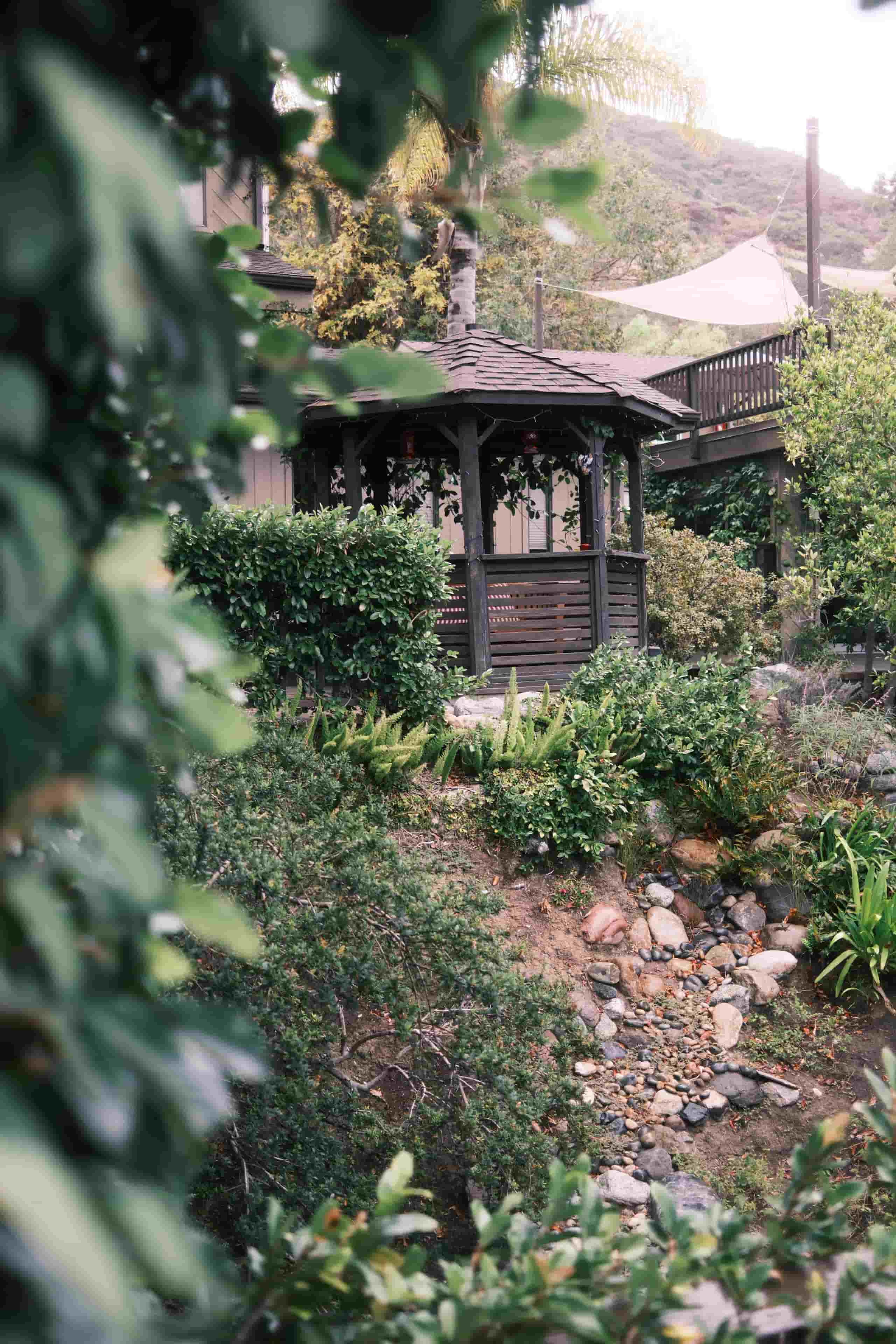
The commonest error is invisible to the person making it. Someone breathing slowly by enlarging the inhale will feel that the practice is not working, and will usually conclude the practice is not for them. In a group of twelve that gets corrected in about ninety seconds; in a group of forty it does not get noticed. The rest of the programme is built so that a session is followed by unstructured time rather than by the next item, which is where the effect has room to settle.
Frequently Asked Questions
How does breathing affect the vagus nerve?
Vagal output to the heart is gated by the respiratory rhythm generated in the brainstem: it is suppressed during inhalation and restored during exhalation. Because vagal activity slows the heart, heart rate rises slightly as you breathe in and falls as you breathe out. Lengthening the exhale increases the share of each cycle spent in the slowing phase, which shifts the average. That coupling is the mechanism behind every calming breathing technique.
Why is six breaths a minute recommended?
Because it is close to the resonance frequency of the baroreflex, the feedback loop that regulates blood pressure. At roughly 0.1 Hz, heart rate and blood pressure oscillate about 180 degrees out of phase, and breathing at that rate reinforces the swing instead of cancelling it, producing unusually large oscillations. Individual resonance varies with blood volume and is lower in taller people and in men, so five to seven breaths a minute is a better range than a fixed count.
Does slow breathing really increase heart rate variability?
Yes. A systematic review and meta-analysis of 223 studies found vagally-mediated HRV increased during slow breathing, immediately after a single session, and after multi-session training. The authors note that the parasympathetic interpretation of that increase is suggested rather than demonstrated, which is a different and more cautious statement than most summaries of this literature make.
Is HRV a measure of vagal tone?
Not directly, and an international expert panel said so explicitly in Nature Reviews Cardiology in 2025. The respiratory component of heart rate variability arises from several mechanisms, and its amplitude should not be read as a measure of vagal tone. Higher resting vagally-mediated HRV is associated with better cardiovascular health at the population level, but an individual daily reading is a much weaker signal than consumer devices imply.
Why does my HRV spike when I do breathing exercises?
Partly for an arithmetic reason. Breathing at around six breaths a minute places your respiratory rhythm inside the low-frequency band used in standard HRV analysis, which inflates that band by construction. The measure rises because of where your breathing rate sits in the frequency spectrum, not necessarily because anything improved. It is a real response to what you are doing, and a weak piece of evidence about your underlying state.
Is breathwork the same as vagus nerve stimulation?
No. Clinical vagus nerve stimulation involves an implanted device delivering electrical pulses to the nerve, used for specific conditions under medical supervision. Breathwork modulates vagal output indirectly through the respiratory rhythm. They share a nerve and nothing else, and the marketing habit of using the clinical term for a breathing exercise is misleading.
Should I use an HRV app or wearable?
If the feedback helps you practise consistently, it is harmless. Treat it as a practice aid rather than a diagnostic: expect the number to rise during slow breathing because that is what the measure does, and judge the practice by how your days go rather than by the chart. Any health concern raised by a wearable reading belongs with a clinician, not with an app.
The Ratio, Corrected in Ninety Seconds
Most people who conclude breathwork does not work for them are making one invisible mistake — breathing slowly by taking bigger breaths in, which works against the mechanism described above.
The Pearl Laguna is an all-inclusive wellness retreat in Laguna Beach, California: twelve rooms, never more than twelve guests, and sessions small enough that someone notices what your inhale is doing. We make no medical claims and we are not a clinical facility.
Written by The Pearl Laguna editorial team on 27 October 2026. This article is for general education and is not medical advice. Breathing practices are not a treatment for any medical or psychiatric condition, and heart rate variability readings from consumer devices are not diagnostic. If you have a cardiovascular or respiratory condition, are pregnant, or have concerns raised by a wearable, speak to a qualified healthcare professional.
- Menuet C, Ben-Tal A, Linossier A, et al. Redefining respiratory sinus arrhythmia as respiratory heart rate variability: an international Expert Recommendation for terminological clarity. Nature Reviews Cardiology. 2025;22:978–984
- Laborde S, Allen MS, Borges U, et al. Effects of voluntary slow breathing on heart rate and heart rate variability: a systematic review and a meta-analysis. Neuroscience and Biobehavioral Reviews. 2022
- Lehrer PM, Gevirtz R. Heart rate variability biofeedback: how and why does it work? Frontiers in Psychology. 2014;5:756
- Zaccaro A, Piarulli A, Laurino M, et al. How breath-control can change your life: a systematic review on psycho-physiological correlates of slow breathing. Frontiers in Human Neuroscience. 2018;12:353
- Grossman P. Fundamental challenges and likely refutations of the five basic premises of the polyvagal theory. Biological Psychology. 2023;180:108589
- Neuhuber WL, Berthoud HR. Functional anatomy of the vagus system: how does the polyvagal theory comply? Biological Psychology. 2022;174:108425
- Yilmaz Balban M, Neri E, Kogon MM, et al. Brief structured respiration practices enhance mood and reduce physiological arousal. Cell Reports Medicine. 2023;4(1):100895
- Fincham GW, Strauss C, Montero-Marin J, Cavanagh K. Effect of breathwork on stress and mental health: a meta-analysis of randomised-controlled trials. Scientific Reports. 2023;13:432
- Breathwork and Mental Health: Can Changing Your Breathing Change Your State?
- The Vagus Nerve Explained: Why Everyone in Wellness Is Talking About It
- Sympathetic vs. Parasympathetic Nervous System
- Nervous System Regulation: What It Actually Means
- What Is a Nervous System Reset? A Science-Based Guide
- The Program: A Complete Reset for Body, Mind and Energy